
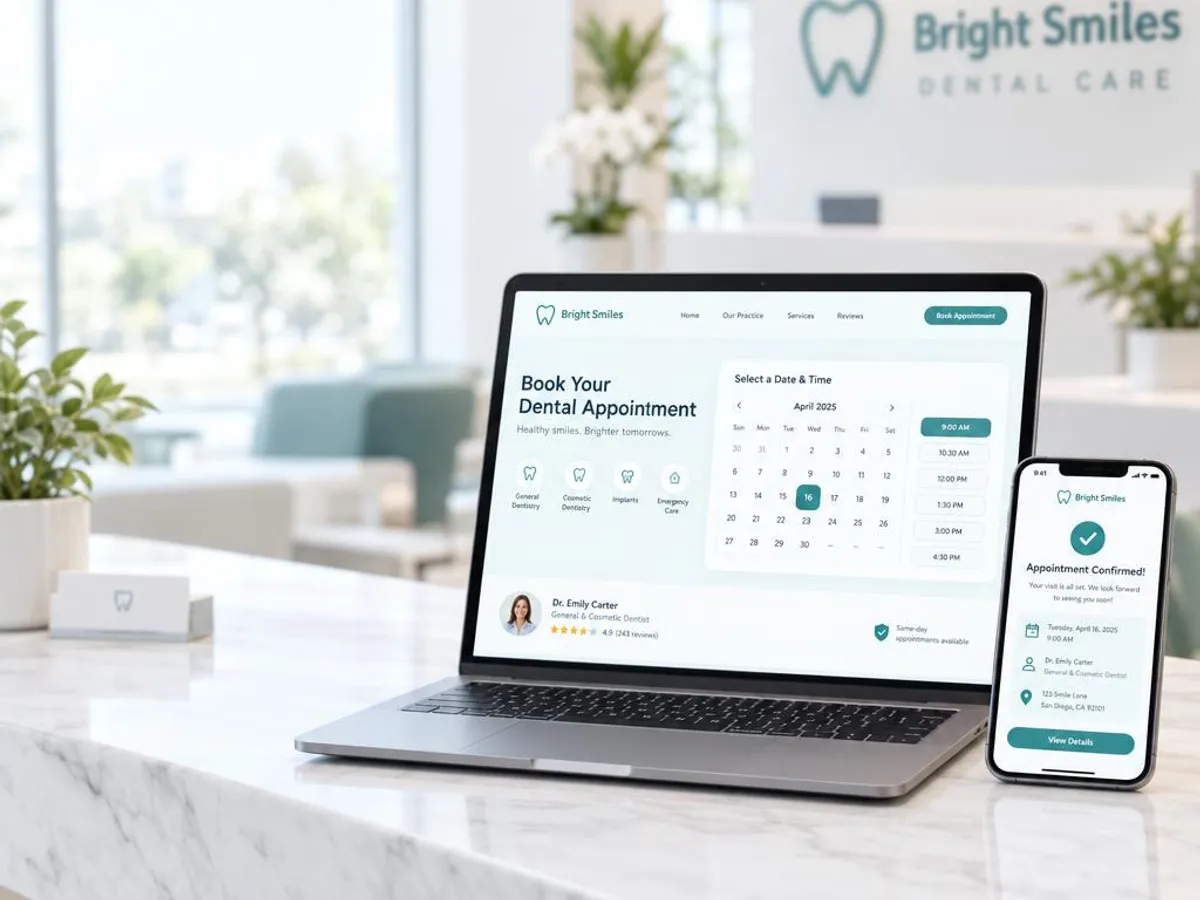
What dental SEO actually is
Dental SEO has three jobs: win the local map pack, rank a dedicated page for each high-value treatment in the suburbs you serve, and make those pages turn visits into bookings, all within AHPRA's advertising rules.
Search engine optimisation for a dental practice is the work of making your website and Google Business Profile the most relevant, trustworthy answer when someone nearby searches for dental care. It covers three connected areas: the map listing that appears for "dentist near me", the organic results beneath it, and the pages on your own site that turn a visit into a booking.
Generic SEO advice treats every business the same. Dentistry isn't the same. Your treatments range from a routine check-up to full-arch implant work, your advertising is regulated under national law, and many patients will only consider practices within a short drive. Good dental SEO starts from those facts rather than working around them.
The goal isn't traffic for its own sake. It's more enquiries for the treatments your practice is set up to deliver and wants to grow, at a cost per new patient that makes sense against what those patients are worth to you.
How patients search for a dentist
Before planning any work, it helps to understand the searches that actually bring patients to a practice. They fall into a few distinct patterns, and each needs a different response.
Near-me and suburb searches
Searches like "dentist near me", "dentist Parramatta" or "emergency dentist open now" are driven by location. Google answers them mostly from the map pack, weighing how close you are, how relevant your profile is and how prominent your practice appears across the web. These are high-intent searches, but they tend to bring general and emergency patients.
Treatment-led searches
Searches like "dental implants cost Sydney", "All-on-4 Brisbane" or "Invisalign near me" come from people researching a specific, often considered treatment. They compare options over some time, read several pages, and look for clear information on process, suitability and fees. These searches are where dedicated treatment pages earn their keep.
Research and reassurance
Questions like "how long do implants last" or "does Invisalign hurt" come earlier in the decision. Answering them well, and honestly, builds familiarity with your practice long before the patient is ready to book.
Your Google Business Profile
For many practices, the Google Business Profile is the most valuable listing they own. It's what appears in the map pack, and it's often the first impression a new patient has of you.
We start by getting the fundamentals exactly right: the primary category, secondary categories for services such as cosmetic or emergency dentistry, accurate opening hours including public holidays, and a services list that mirrors the treatments on your website. Small inconsistencies (a different phone number, an old address, a missing suite number) quietly weaken your visibility.
From there, the profile needs ongoing care. Regular photos of the practice and team, posts about new services or extended hours, and prompt, professional responses to reviews all signal an active, trustworthy practice. More on this in local SEO for dentists.
Patients can leave reviews on Google, and you can reply to them. What you can't do under AHPRA's guidelines is republish those reviews as testimonials on your own website or in advertising. We manage the profile with that line in mind.
Treatment pages that earn high-value enquiries
If you want more implant or Invisalign patients, you need pages that deserve to rank for those searches. A single "Services" page with a paragraph on each treatment rarely does. Each high-value treatment needs its own page, written for the person considering it.
Implants and All-on-4
Implant patients want to understand the process, the timeline, who is suitable and what drives the cost. A strong page explains the stages plainly, introduces the dentist who performs the treatment with their qualifications stated accurately, and sets expectations without overpromising. Where fees vary, we explain why, and point to the consult as the place to get a real figure. See dental implant marketing.
Invisalign and orthodontics
Clear aligner searches are competitive and heavily advertised. Pages that stand out explain how treatment works at your practice, how long it usually takes, what happens at the first appointment and how it compares with other options.
Emergency dental
Emergency searches are urgent and local. The page needs to load fast, show your phone number immediately, state when you can see emergency patients, and make it simple to call.
Technical foundations
Even the best content struggles on a slow or confusing website. Our technical work makes sure Google can crawl, understand and trust every page, and that patients on a phone can find what they need quickly.
That usually includes page speed and Core Web Vitals, mobile layout, a clean URL structure, internal links between treatments and locations, and structured data that tells Google your practice name, address, hours and services in a format it reads reliably. We also look for the less visible problems: duplicate pages, broken links, old treatment pages left behind after a redesign, and booking widgets that slow everything down. More in dental website design.
Local authority and citations
Google looks beyond your own website to judge how established a practice is. Consistent listings in reputable Australian directories, mentions on local community sites, and links from relevant organisations all contribute.
We keep your name, address and phone number identical across every listing, clean up duplicates, and pursue genuine local mentions rather than bulk link schemes. For groups, each location is treated as its own local business, with its own citations and landing page.
Suburb and city pages
Your map listing is tied to your address, but patients travel from surrounding suburbs too, particularly for implants, All-on-4 and orthodontics, where they'll happily drive further for the right practice. Well-built location pages help you appear for those searches without pretending to be somewhere you're not.
The difference between a useful location page and a thin one is substance. We write each page around genuine local detail: travel time and parking, public transport, the treatments patients from that area most often ask about, and how to book. Copy-and-paste pages with only the suburb name swapped rarely rank, and they don't help the patient reading them either.
For city-level searches in Sydney, Melbourne, Brisbane and other capitals, competition is intense. There, we focus effort on the specific treatments and neighbouring suburbs where your practice has a realistic chance to lead, rather than chasing broad terms that bring traffic but few bookings.
Writing within AHPRA's advertising rules
Dental advertising in Australia is regulated under the Health Practitioner Regulation National Law, and AHPRA's guidelines apply to your website, profiles and ads alike. That shapes how we write.
We don't use testimonials on your site. We avoid claims that could mislead, such as promising outcomes or describing treatment as painless. We use before-and-after images only where they're realistic and accompanied by appropriate context, and we don't use offers that could encourage unnecessary treatment. We describe practitioners' titles accurately, and only use "specialist" where the dentist holds specialist registration.
None of this makes the copy timid. Clear, honest explanation of treatment is exactly what considered patients are looking for.
No testimonials. No outcome guarantees. Images used with context. Titles stated correctly. You approve all copy before it goes live, and where something is genuinely unclear, we flag it for your own advice.
Measuring what matters
Rankings are a means, not the end. What matters is how many patients enquire, for which treatments, and from where.
We track phone calls, form submissions and online bookings, and tag each one by the treatment page it came from wherever possible. Your monthly report shows enquiries by treatment alongside visibility for your priority searches, so you can see where growth is coming from and where we're focusing next. It's written in plain English, and we walk you through it.
8:12Phone call · 4m 18sImplant consultOrganicQualified
12:40Online bookingInvisalign consultMapsQualified
9:05Phone call · 0m 52sPublic dental enquiryAdsNot a fit
17:31Web formEmergency toothacheOrganicQualified
What to ask any dental SEO provider
Whether you work with us or someone else, a few questions quickly separate careful work from cookie-cutter packages. Ask them early, and expect straight answers.
- i.Will you work with my competitors?An agency running SEO for two practices in the same suburb is competing against itself. We work with one practice per postcode, so the question never arises.
- ii.Who owns the website, content and accounts?You should. Your Google Business Profile, analytics, ad accounts and the pages written for you belong to the practice, and stay with it if you ever move on.
- iii.How will you handle AHPRA's guidelines?A provider who suggests adding testimonials to your homepage, or promises results, hasn't read them. Ask to see how they review copy before it's published.
How long dental SEO takes
SEO compounds rather than switching on. Fixes to your Google Business Profile and technical issues are usually the first things to move. New treatment pages typically take a few months to settle and climb, and competitive terms in large cities take longer still.
We set expectations in your strategy based on your competition and starting point, not a generic promise. If you need enquiries sooner, Google Ads for dentists can run alongside SEO while organic visibility builds, then scale back as it takes over.
The best place to start is knowing where you stand today. Your free audit shows how your practice appears for your priority treatments and suburbs, what's holding it back, and what we'd tackle first.