
When paid search makes sense for a dental practice
Dental SEO compounds over months. Google Ads can bring enquiries from the day a campaign is live. That timing difference shapes when ads are worth running: a new practice building its organic presence from scratch, an established practice that has added a high-value treatment and needs enquiries while the treatment page climbs, or a practice competing in a market where the top organic positions are held by well-established competitors.
Ads are also well suited to treatments where the patient decision is considered and the value of each new patient is meaningful. Implants, All-on-4 and Invisalign sit at one end of that range. A focused campaign targeting a single high-value treatment in a defined area can be more efficient than a broad campaign covering every service, because the ad copy, the target searches and the landing page can all be built around one specific patient and one specific decision.
Where local SEO handles the map pack and near-me searches organically, Google Ads can reach patients searching for specific treatment-plus-suburb combinations that would take time to rank for organically. The two work well alongside each other. When organic rankings for a treatment are established, ad spend on that term can be reduced and redirected toward a treatment or area still building its organic presence.
Campaigns per treatment and per location
A single campaign covering every dental service is hard to run well. Budget competes across very different searches, ad copy cannot be specific to any treatment, and it is difficult to see which services are actually generating enquiries. We structure campaigns separately by treatment group and, for practices with multiple locations, by site.
High-value treatment campaigns
Dental implants, All-on-4 and Invisalign each get their own campaign. The patient researching implants is in a different state and asking different questions from the one looking for clear aligners. The search terms, the ad copy and the landing page for each are distinct. Bundling them together means compromising all three. For more on the strategy behind these, see dental implant marketing, All-on-4 marketing and Invisalign marketing.
Emergency dental
Emergency searches are urgent and often made on a phone. A campaign for emergency dental runs with call options prominent, directs to a page that loads quickly and shows your phone number immediately, and is scheduled to run only during your opening hours. Running emergency ads outside those hours wastes budget and creates a poor experience for a patient in pain.
Location-based structure for groups
For a practice group with multiple sites, each location runs its own campaigns with its own budget, targeting and reporting. This means you can see clearly how each site is performing and adjust spend to match the capacity and priorities at each location, rather than spreading budget evenly across the group.
Negative keywords: what to exclude from the start
Without a carefully maintained exclusion list, a dental implant campaign will spend budget on patients looking for free implants, bulk billing options, public dental clinic information, dental nursing jobs, or DIY dental products. These clicks cost money and produce no new patients.
We build the negative keyword list before a campaign launches. For any dental campaign this covers: searches containing "free", "bulk billing" and "public dental"; searches indicating employment intent such as "jobs", "career" and "salary"; course and study searches; and searches for products rather than professional treatment. For implant campaigns in particular, terms suggesting a patient is researching self-treatment are worth excluding from the outset.
Negative keywords are not a one-time setup task. We review search term reports throughout the campaign and add new exclusions as irrelevant searches surface. A list that is not maintained will gradually erode over time as patterns in those reports are ignored.
Excluding competing treatment types is also worth considering. A patient searching for partial dentures is likely not looking for implants, and showing them an implant ad uses budget without matching their intent. We review this treatment-level exclusion at campaign setup based on the specific services you offer.
The initial exclusion list is a starting point, not a finished piece of work. Google's matching can surface searches you didn't anticipate when you built the campaign. Reviewing search terms monthly and adding new negatives is part of regular campaign maintenance, not an optional extra.
Radius targeting and ad scheduling
Dental patients are geographically bounded. For a check-up or clean, many patients prefer to stay close to home. For implants or All-on-4, they may cross a metro area for the right practice. The targeting radius for each campaign should reflect how far patients realistically travel for that treatment.
We set location targeting around the practice address for each campaign, tighter for general and emergency services and wider for high-value elective treatments. This keeps budget focused on the patients most likely to book rather than spreading reach across an area where conversion is low.
Scheduling keeps ads running when the practice can actually respond. Emergency dental campaigns are scheduled during opening hours only. Implant and cosmetic campaigns can run at any hour, since a patient researching late in the evening may call or book the following morning. For practices with an online booking system, we review scheduling against booking patterns once enough data is available.
For practices with a click-to-call option, we set up call tracking so that phone calls driven by ads are logged separately from organic calls. This gives a clear picture of what each campaign is actually contributing, rather than a blended total that makes it difficult to judge performance.
Landing pages per treatment
Sending an ad click to the practice homepage wastes spend. The patient arrived looking for a specific treatment. If the next page they see is a general overview of everything the practice offers, many will leave without enquiring. Each campaign needs a landing page focused on the treatment it targets.
An implant landing page should explain the process in plain terms, introduce the clinician performing the treatment with their qualifications stated accurately, and make it simple to book a consultation. It does not need to be long, but it does need to address the questions a patient has when they click the ad. The same applies to Invisalign, All-on-4 and any other treatment with its own campaign.
Where a practice already has a well-built treatment page from their dental SEO work, that page can often serve as the landing page directly. Where the existing page is thin or not built around a booking action, we build a dedicated landing page that sits alongside the organic content rather than replacing it.
Ad copy within AHPRA rules, budget and reporting
Dental advertising in Australia is regulated under the Health Practitioner Regulation National Law, and AHPRA's advertising guidelines apply to paid ads in the same way they apply to your website and Google Business Profile. This means no patient testimonials in ad copy, no claims of guaranteed outcomes, no descriptions of treatment as painless or without risk, and any offer or promotion must clearly state its terms. Using specialist titles in ads is appropriate only where the practitioner holds specialist registration with the Dental Board of Australia.
Writing within those rules
Clear, accurate copy tends to perform well regardless of the constraints. An ad that explains what the consultation involves, states the practice location, names the treatment and includes a direct action will generally do better than one relying on vague claims. We write ad copy that is factually correct, matches the search intent and does not overstate what the practice offers. You approve every ad before it runs.
Budget
We do not recommend a budget from a generic formula. The right level depends on your location, the treatments you are targeting and the competition in your area. We recommend starting with a defined scope, either a single treatment or a single location, measuring the cost per enquiry over the first few months, and then deciding whether to expand based on that data.
Plain-English reporting
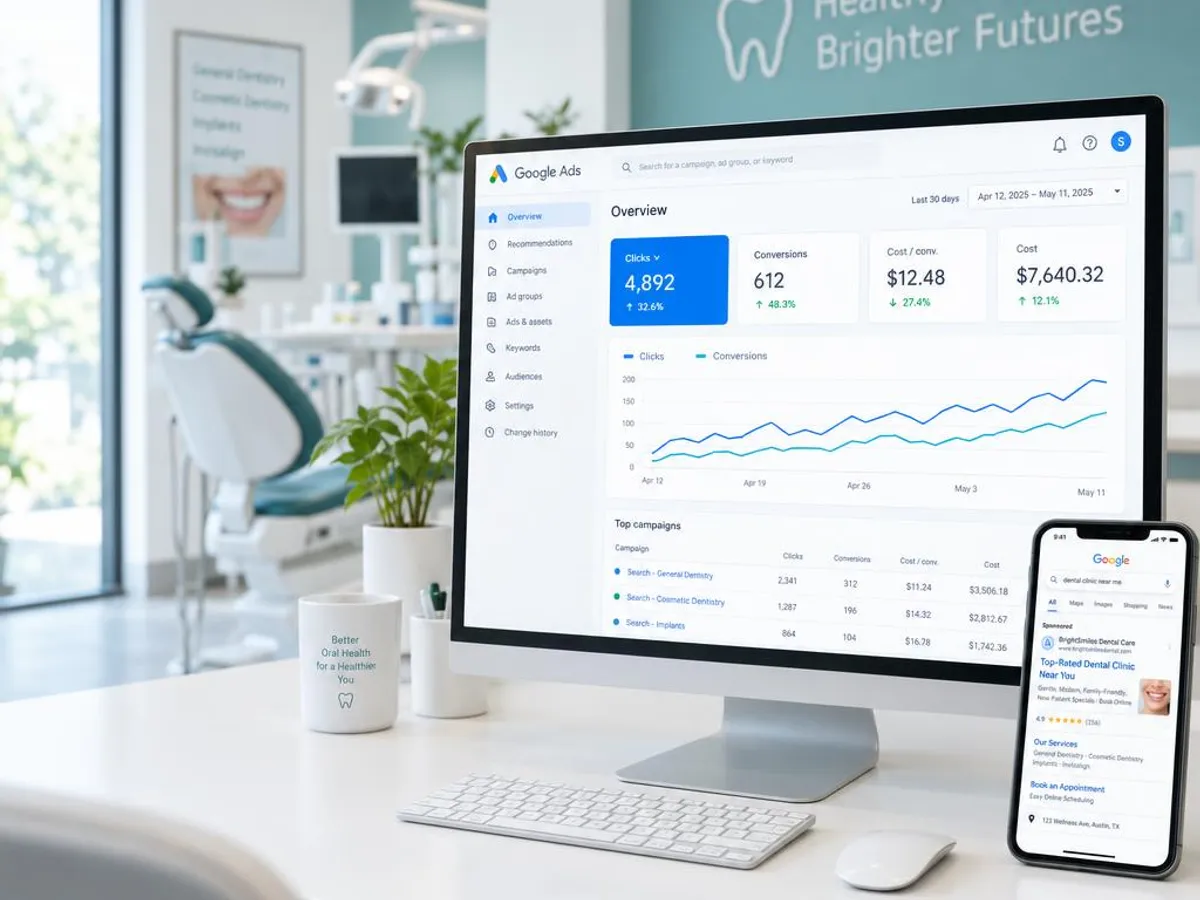
Your monthly report covers enquiries by treatment campaign, cost per enquiry, and the search terms that triggered your ads, alongside any adjustments made and what is planned next. It is written in plain English, and weekly progress updates cover what changed in between. You own the account from day one, so you can verify every figure yourself and hand it to another provider if you ever move on. The ads report sits alongside your local SEO tracking data in a single practice overview so you can see the full picture of where new enquiries come from.