
Why local SEO is different from organic SEO
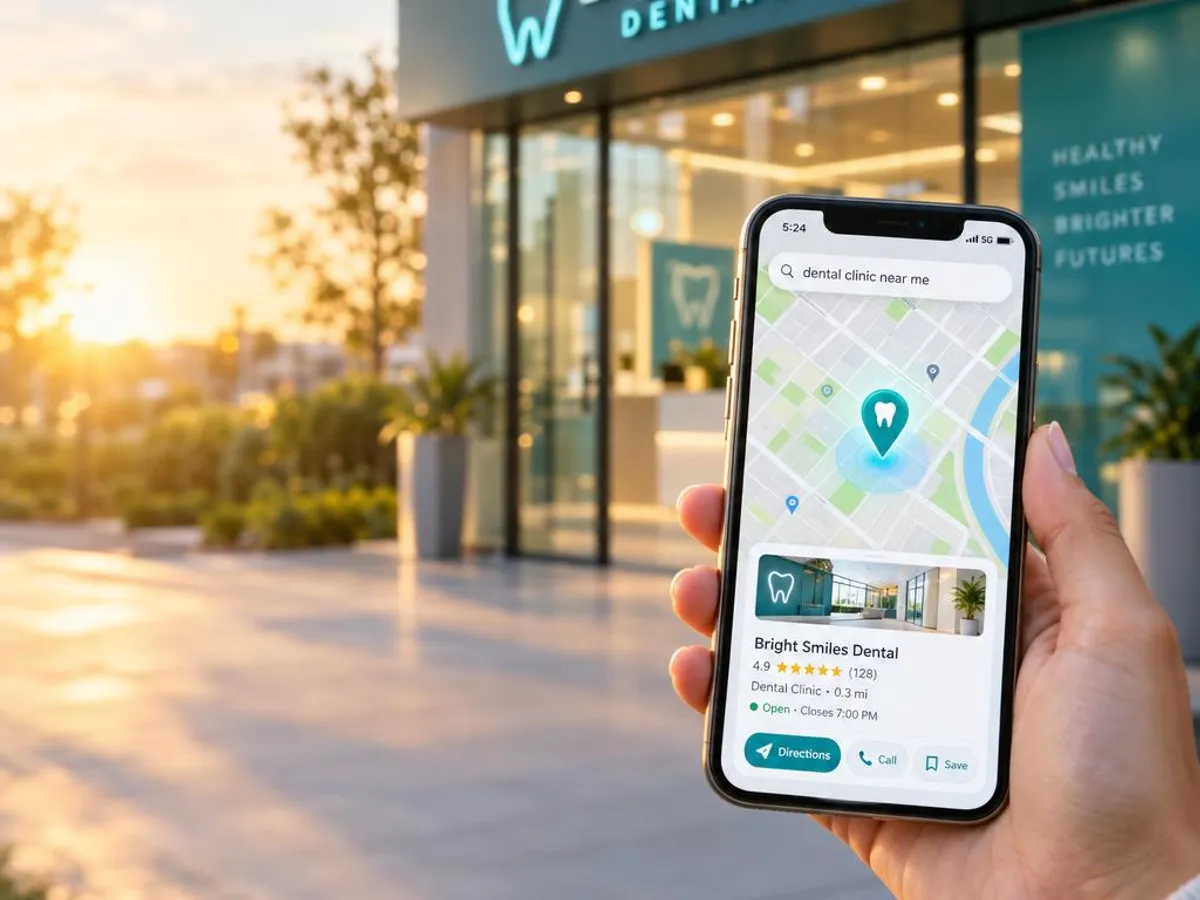
Local SEO focuses on searches with a clear location signal: "dentist near me", "emergency dentist Parramatta", "dental implants Blacktown". Google often answers these with a map pack, the cluster of business listings that appears above the organic results. Getting into that cluster is a distinct challenge from ranking a treatment page in the blue organic links, and it requires different work.
For a dental practice, local search handles the most time-sensitive enquiries. A patient looking for emergency care or a check-up close to home will often book directly from the map pack without reading anything further. Your Google Business Profile and local signals are therefore more immediately useful for general and emergency demand than a well-optimised treatment page, even though both matter for a complete strategy. The full picture is in dental SEO.
Google says local results are based mainly on three things: relevance to the search, distance from the searcher, and how prominent the practice is, online and off. Each of those can be improved, but the work is different from building organic rankings. This page covers each in turn.
Building a complete Google Business Profile
A half-completed profile sends weak signals. The details that are easy to skip are often the ones that carry the most weight.
Primary category and secondary categories
The primary category tells Google what your business fundamentally is. For a general practice, that is "Dentist". Secondary categories let you signal specific services: emergency dental, cosmetic dentistry, paediatric dentistry, and others. Where a registered specialist is on the team, for example an orthodontist or oral surgeon with specialist registration, the relevant specialist category can be added. Secondary categories should reflect what you actually offer, and each one is another signal that your profile is relevant to patients searching for that care.
Services list
The services section should mirror the treatments your practice actively offers. Check-ups and cleans, tooth whitening, dental implants, clear aligners, root canal treatment, wisdom tooth removal, mouthguards: each service you list is another relevance signal for patients searching for that treatment in your area. The list should match what is on your website so there is no contradiction between the two. Where a treatment page exists for dental implants, Invisalign or any other high-value service, the matching service entry in the profile reinforces both.
Hours including public holidays
Inaccurate hours are an easy way to lose a patient. A patient who calls at a time your profile says you are open and reaches voicemail is unlikely to try again. Update your hours before each public holiday period, not after. Late evening or Saturday appointments should be stated clearly: they are often what tips a patient toward your practice over a competitor with standard hours.
Photos
Photos of the practice exterior, reception, treatment rooms and the team help patients know what to expect before they arrive. A profile with a varied, regularly updated photo set signals an active, well-maintained business. We provide a brief for each practice covering what to shoot, and refresh photos as a team or the rooms change.
Posts
Posts about new services, changed hours or a new clinician show the profile is actively managed. They do not need to be frequent: a consistent cadence matters more than volume. Every post is checked against AHPRA advertising guidelines before it is published.
One profile per location for practice groups
A practice group with two or more sites needs a separate Google Business Profile for each location. Google expects each location to have its own profile, and a patient looking for the closest site needs to see that site’s own address, hours and phone number.
Each profile gets its own address, phone number, opening hours, services list and photo set. The name on each profile should include the location in a way that is consistent and natural across the group, for example "Harbourside Dental Parramatta" and "Harbourside Dental Blacktown". Each site also needs its own landing page on the website: a real destination that reinforces the local signals and gives patients somewhere to arrive with clear booking and contact information.
Managing several profiles requires a system. We maintain each independently and report on each location separately, so the group can see how individual sites are performing and act on that information rather than working from a single blended figure.
Reviews, responses and the AHPRA testimonial line
Google reviews are a visible trust signal and a factor in local prominence. Practices with a steady volume of genuine reviews, spread across recent dates, tend to maintain a stronger local presence than those whose reviews came in a single burst some time ago.
Patients may freely leave reviews on Google, and practices may respond to them professionally. What is prohibited under AHPRA's advertising guidelines is republishing those reviews as testimonials: on your website, in brochures, in ads or in any other advertising material. We manage every profile with this distinction in mind. Responses stay on Google where the review appeared, and nothing is moved across to your site as a quote, a star rating display or a patient story.
Responding to reviews, including negative ones, shows potential patients that the practice is attentive. A calm, professional reply to a critical review can reassure a prospective patient reading it later. Replies never confirm that the reviewer is a patient or discuss their care, which would raise privacy problems. We draft responses for your approval and post them on your behalf.
Building review volume over time requires a simple, consistent process. We can help you set up an AHPRA-compliant way to remind patients that leaving a review is an option, making it easy to do so without pressure or incentives.
Suburb pages that rank without doorway duplication
Your map listing is anchored to your physical address, but patients travel from surrounding suburbs, particularly for dental implants, All-on-4 and orthodontics, where many are willing to travel further for the right practice. Location pages for the suburbs you serve help you appear in organic results for patients who search by suburb name rather than with a near-me query.
The risk with suburb pages is thin, duplicated content. A page that simply swaps the suburb name into the same template is unlikely to rank, and a large set of near-identical pages can weaken a site overall. Each page we write is grounded in something genuinely specific to that area: the nearest train station or car park from that suburb, travel time and direction, the treatments patients from that direction most often ask about, and how to book. The goal is a page a patient from that suburb would actually find useful, not a page built only to capture a keyword.
The right number of suburb pages varies by practice. We plan the set based on where your patients actually travel from, the treatments that attract patients from further away, and where there is realistic room to rank given local competition. We start with the suburbs closest to your practice and expand from there as early pages build traction.
Citations and Australian directories
A citation is any mention of your practice name, address and phone number on another website. Consistent, accurate citations across reputable directories reinforce the local signals that confirm your practice exists where you say it does.
For Australian dental practices, relevant directories include general Australian business listings, healthcare-specific platforms, and the professional listings tied to registration and peak bodies. Inconsistencies across these, a slightly different address format, an old phone number, a missing suite or floor number, quietly undermine the local signals you are trying to build. We audit existing citations, correct errors and add your practice to the directories where it should appear but does not.
We do not pursue citations in bulk or use schemes that generate listings at scale. The value is in accurate, relevant mentions on platforms that patients and Google actually trust. For how citation work fits alongside content authority and link signals, see dental SEO.
Tracking calls, directions and bookings from Maps
Your Google Business Profile generates calls, direction requests and website clicks. These are patient actions that come directly from local search and map results, and they are worth tracking separately from enquiries that arrive through your website alone.
Google provides profile performance data within the Business Profile management interface. We review this alongside your website analytics and call tracking each month, so you can see the complete picture: a Maps call, a direction request that led to a walk-in, a website visit from the profile, or a form submission from a suburb page. Each source gets its own line in your monthly report, written in plain English.
For online bookings, we add your booking link to the profile so that patients can start a booking from the map results without hunting through your website first. We check the booking link is working as part of regular profile maintenance.
Local SEO and Google Ads for dentists work well alongside each other. Maps visibility handles high-intent, location-driven searches organically, while ads can target specific treatment-plus-suburb combinations in areas where organic rankings will take longer to build. Your free audit shows where each approach is likely to have the most impact for your practice.